
Best Yoga Mat Exercises to Relax Your Pelvic Floor
Mar 30, 2026If you’ve been searching for yoga mat exercises to help with leaking, lower back pain, or reconnecting with your core muscles, you’re in the right place. A lot of home workouts and fitness routines focus on burning calories, improving body composition, or helping you "crush belly fat" (sigh), but very few actually address what’s happening deep inside your core system.
Why do I need to relax my pelvic floor?
For many pregnant and postpartum moms, the issue isn’t that you’re not doing enough. It’s that your body is already doing too much in the wrong way. Your pelvic floor might be constantly engaged, which means it doesn’t know how to respond when you actually need it to.
That’s why these yoga mat exercises are different. They’re not just about getting in a great workout or raising your heart rate. They’re about helping your body learn how to move, release, and build strength in a way that actually supports your daily routine.
Why yoga mat exercises are essential for pelvic floor health
Most fitness workouts are built around strengthening the upper body, lower body, or entire body through repetition and intensity. You’ll see things like mountain climbers, diamond push-ups, static holds, and high plank variations promoted as the best fitness mat exercises, and while they can be helpful in the right context, they don’t always address pelvic floor function.
Your pelvic floor is part of a pressure system that works with your diaphragm and core muscles. It needs to respond dynamically, which means it should be able to relax and contract depending on what your body is doing. If that system is off, even the most effective workout routine won’t give you the results you’re looking for.
Inside my free pelvic floor guide, I explain how this pressure system works and why symptoms like leaking, heaviness, or pain often come from mismanaged pressure rather than a lack of strength. This is especially important if you’ve been doing core exercises consistently but not seeing the changes you expected.
How yoga mat exercises support mental health and nervous system regulation
One thing that doesn’t get talked about enough is how much your pelvic floor is connected to your nervous system and mental health. If your body is constantly in a state of tension, whether from stress, lack of sleep, or the demands of caring for a baby, that tension often shows up physically in your hips, jaw, and pelvic floor.
This is where yoga mat exercises become more than just a physical practice. When you slow down, focus on your breath, and move in a controlled manner, you’re sending a signal to your body that it’s safe to relax. That shift alone can make a huge difference in how your entire system functions.
This is also why meditation is such an important practice for moms. Not only does meditation help you manage and respond to stress, it also helps your muscles literally (physically) relax, which is so important for your pelvic floor.
You might notice that after even a short session of meditation on your exercise fitness mat, your shoulders feel softer, your breathing feels deeper, and your body feels a little less “on edge.” That’s not random. That’s your nervous system responding.
Over time, this creates a positive feedback loop. As your body learns to relax, your pelvic floor can function more effectively, which means your core strength improves, and your overall sense of well-being increases. It’s a simple practice, but it has a ripple effect across your entire body.
How yoga mat exercises improve core stability and prevent lower back pain
One of the biggest added benefits of these yoga mat exercises is how they support core stability in a way that actually supports your lower back. A lot of traditional core exercises focus on bracing or holding tension, which can feel like you’re building strength but often leads to more tightness and discomfort over time.
When your pelvic floor, diaphragm, and deep core muscles are working together, your body naturally creates support from the inside out. This means less strain on your lower back, better posture, and more ease in your daily routine, whether you’re lifting your baby, standing for long periods, or moving through simple exercises at home.
This is also why these exercises are such a great way to ease into fitness workouts after pregnancy. Instead of jumping straight into high-intensity routines or trying to hit aggressive weight loss goals, you’re building a foundation that supports everything else you want to do. Over time, this leads to more efficient movement, better muscle strength, and a body that feels more stable and responsive.
Best yoga mat exercises start with coordination, not intensity
It’s easy to assume that if something feels hard, it must be working. That mindset shows up a lot in fitness culture, especially with intense variations of these exercises or full-body strength training programs that promise a powerful kick start to your fitness goals.
But when it comes to your pelvic floor, harder is not always better. If your muscles are already tight, adding more intensity can actually make things worse. This is why so many women feel stuck, even when they’re consistent with their workout routine.
Instead of focusing on intensity, the best yoga mat exercises for pelvic floor relaxation focus on coordination. They help your body understand when to engage and when to release, which is what builds true core strength and supports better posture over time.
Best yoga mat exercises for pelvic floor relaxation and strength
Before we go through the exercises, I have one important note to share. Because of website / tech limitations, I can’t include photos here, but inside my Relax Your Pelvic Floor guide, I show you each movement with detailed visuals and explanations so you can follow along confidently.
That guide also walks you through how your breath connects to your pelvic floor and why that connection is the foundation for everything we’re doing here.
Breath work: Your starting point yoga mat exercise for pelvic floor control
Breath work might not look like a traditional exercise fitness mat routine, but it’s one of the most important things you can do. When you breathe well, your diaphragm and pelvic floor move together, creating a natural rhythm that supports your entire body.
Now let's put that into practice. Here's what I want you to do:
- Lie on your back or sit comfortably on your mat.
- Place one hand on your ribs and one on your belly.
- As you inhale, let your ribs expand in all directions.
- As you exhale, feel everything gently settle.
This simple practice helps regulate pressure in your system and is one of the most effective ways to support both relaxation and strength at the same time.
Foam rolling: The next step yoga mat exercises for full-body support
Foam rolling might not be the first thing you think of when you think about yoga mat exercises, but it plays a key role in how your body functions. Tightness in your glutes, inner thighs, and mid-back can limit how your pelvic floor responds during movement.
Sit on your roller and cross your right foot over your left leg. Move slowly through the glutes, then switch sides. You can also roll through the inner thighs and mid-back, paying attention to how your body responds.
This is not just about release. It’s about giving your body the input it needs to build strength in a more balanced way, which is something most home workouts overlook.
Malasana: One of the best yoga mat exercises for lower body mobility
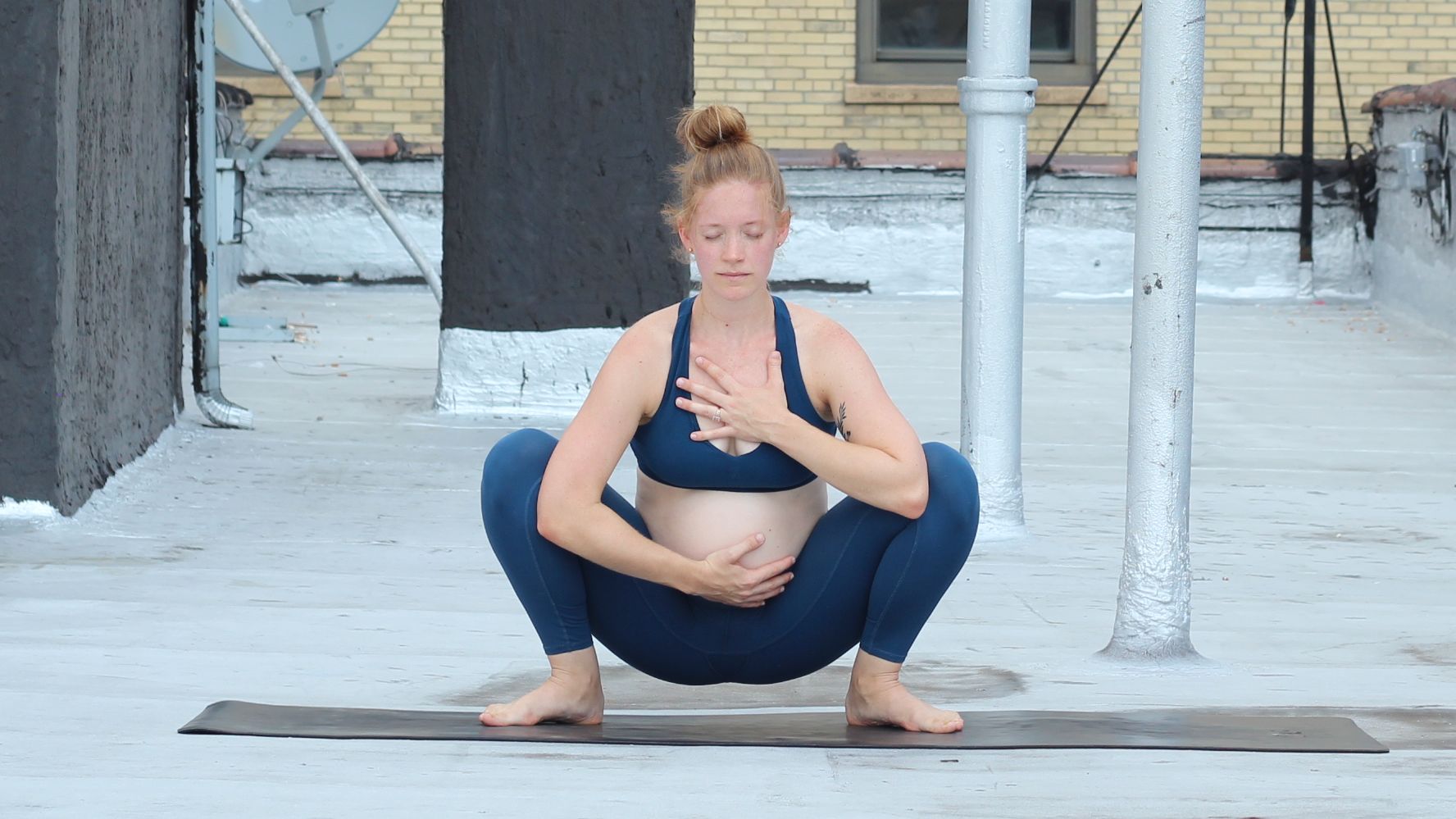
Malasana is one of the best yoga mat exercises for improving lower body mobility and flexibility and encouraging pelvic floor lengthening. It also supports hip stability and helps improve your range of motion, which is important for both exercise and everyday movement.
Stand with your feet wider than hip-width apart and lower into a squat. Keep your chest lifted and your spine long, forming a straight line from your head to your tailbone. If your heels lift, place something underneath them for support.
Focus on your breath rather than forcing depth. This position should feel supportive, not strained.
Pigeon pose: A yoga mat exercise for deep hip release
From a tabletop position, bring your right knee forward and extend your left leg back. Lower down onto your forearms and allow your body to settle into the position.
Keep your right knee supported and your right hand relaxed. Notice what your body does here. If your shoulders tense or your jaw tightens, that’s just information. Try not to assign moral value to it ("Ugh, I'm so tight! This is so bad!").
Figure 4 stretch: A gentle yoga mat exercise alternative
If pigeon feels too intense, the figure 4 stretch is a great alternative. Lie on your back, bend your knees, and cross your right ankle over your left thigh. Draw your legs toward your chest in a controlled manner.
Keep your shoulders relaxed and your breath steady. This exercise is especially helpful if you’re dealing with lower back pain or just getting started with yoga mat exercises.
What to avoid in your yoga mat workout routine
Many popular exercises like mountain climbers, high plank, diamond sit-up, or even certain pilate exercise variations can increase pressure in your core system. If that pressure is not managed well, it can push down into the pelvic floor or out through the midline.
That doesn’t mean you can never do these exercises. It just means they’re not your starting position. Building a strong foundation first will make everything else more effective later.
A simple yoga mat exercises routine for busy moms
You don’t need a long or complicated routine to see progress or improvement. In fact, a simple, consistent approach is often the most effective.
Try this easy home workout structure:
- 2 minutes of breathwork
- 2 to 3 minutes of foam rolling
- 2 to 3 minutes of one hip opener
- 1 to 2 minutes of malasana
This kind of routine fits into a busy routine, doesn’t require expensive equipment, and can be done anywhere.
How yoga mat exercises support long-term fitness goals
These yoga mat exercises may not feel like a traditional great workout, but they are building something much more important. They are improving your core stability, supporting better posture, and helping your body manage pressure more effectively.
Over time, this leads to significant improvements not just in how you feel, but in how your body performs during other fitness workouts and daily activities.
When you’re ready to progress, this foundation allows you to safely add more intensity, whether that’s resistance band work, full-body strength training, or more advanced core exercises.
Where to go next
If you want to go deeper with this, watch my Relax Your Pelvic Floor video here. And make sure to download my Relax Your Pelvic Floor guide walks you through these exercises step by step with visuals and added guidance.
And if you’re ready to build strength in a way that actually supports your body, Core Power takes you through a structured progression so you can move forward with confidence.
Remember, you don't need a million kegels or endless hours of meditation. You need a mindful and structured approach that's going to build pelvic floor strength the right way.
get more like this
straight to your inbox, every Monday morning!
