What if you could have a short labor with no tearing?
Most pregnant moms think it's either random luck or a million kegels that will get them there. In one 30-minute live class, you'll learn exactly what to do instead.
NEXT LIVE CLASS: TUESDAY, OCT 20 · 1 PM ET
Live masterclass + Pelvic Floor Cheat Sheet + 48-hour replay. All for $27.
You're not alone in this.
"I'm so scared of tearing. I've heard such terrible stories and I can't stop thinking about it."
You're lying awake with one hand on your belly, feeling your baby move. It should feel like a miracle. Instead, all you can think about is what's coming.
The birth. The tearing. The hours of labor. The possibility of ending up in an emergency you didn't prepare for. You've heard the stories — from your mom, your sister-in-law, the woman in the grocery store who felt compelled to share every graphic detail. And now those stories live in your head on repeat.
You try affirmations. You download the apps. You tell yourself to trust your body — but no one has actually explained what that means or how to do it.
And underneath all of it, there's this quiet, persistent question: Does it really have to be this scary?
I'm here to tell you it does not. That's exactly why this masterclass exists.
Here's what nobody told you:
You've been given the wrong advice about your pelvic floor.
And following it could make birth harder, not easier.
I'm ready to learn the RIGHT way!WHAT YOU'VE BEEN TOLD:
❌ Your pelvic floor is weak. Do kegels. Squeeze, squeeze, squeeze.
WHAT'S ACTUALLY TRUE:
✅ For most pregnant moms, the pelvic floor is actually too tight — and kegels alone can make that worse.
WHAT YOU'VE BEEN TOLD:
❌ Your pelvic floor pushes your baby out during labor.
WHAT'S ACTUALLY TRUE:
✅ Your uterus does the pushing. Your pelvic floor has to get out of the way. If it can't relax, it becomes the obstacle.
WHAT YOU'VE BEEN TOLD:
❌ A tight pelvic floor is a strong one.
WHAT'S ACTUALLY TRUE:
✅ A tight pelvic floor is likely a weak one. It's so fatigued it can't fully engage when you need it — or release when you need it to.
If your pelvic floor can't fully relax, your baby has to push through resistance on the way out. That can contribute to longer labors, more tearing, and a harder recovery.
Your body may already be signaling this:
These "normal" pregnancy symptoms aren't just annoying. They might be telling you something important about your birth.
A tight pelvic floor doesn't always announce itself. Sometimes it shows up as things you've written off as just part of pregnancy.
• Leaking when you sneeze, cough, or laugh
• Tailbone or lower back pain
• Heaviness "down there"
• Constipation that just won't. give. up!
• Painful sex
• Avoiding certain movements
Stress, being on high alert, a ramped-up nervous system: these are all things that can make your pelvic floor tense up. A tight pelvic floor can mean a body that resists the progress of labor.
If your body is already showing these signs, it's telling you something that matters for your birth — right now, while there's still time to do something about it.
I want to do something about it!!Let me guess...
You're pregnant and:
✓ You're terrified of tearing, a long labor, or losing control in the delivery room.
✓ You've been told to "just do your kegels" and something about that advice has never felt right.
✓ You've tried affirmations, breathing apps, maybe even a hospital birth class — and you still feel unprepared.
✓ You want to understand the actual mechanics of your body, not just be told to "trust it."
✓ Last time was traumatic, and you're determined to walk into this birth differently.
✓ You're experiencing symptoms like leaking, pressure, or tailbone pain and you want to know what they mean for your birth.
"Everyone says trust your body.
But HOW? I don't even know what that means."
Let me show you how for $27 →I've been exactly where you are.
I was at happy hour with coworkers, cringing as they exchanged birth horror stories. They didn't know my husband and I had just decided to start trying for our first baby. Hearing those stories made me wonder if we'd made a terrible mistake.
But one friend leaned over and whispered: "It doesn't have to be that way."
Those words sent me down a years-long obsession with understanding how birth actually works — the mechanics, the breath, the pelvic floor, the mindset. And eventually, they became the foundation for everything I teach.

At 37 weeks pregnant, I looked at my midwife and said, "I don't know if I can do this." I genuinely couldn't picture a baby coming out of my body. What if I wasn't strong enough? What if I failed?
She said, "Oh honey, yes you can." I chose to believe her.
What I didn't know then was that I'd already been doing the exact things your pelvic floor needs to release and progress labor — I just didn't have the language for it yet. I was envisioning birth by reading other women's stories (turns out I was literally training my brain to accept birth as possible, not terrifying). I was releasing tension through moaning and lip fluttering. I was meditating on affirmations. I was setting up a calm environment so my nervous system could relax and let my body do its thing.
200-hr Certified Yoga Teacher
Preg & PP Corrective Exercise Specialist
6 Years Teaching Pregnant Moms
Mom of 3
I'm not a pelvic health PT, and I'm not a doctor. I'm a certified prenatal yoga teacher and corrective exercise specialist who has spent 6+ years obsessing over how to help pregnant moms actually prepare for birth — not just survive it.
I push back against the idea that traumatic births are just how it goes, that your body is a mystery you can't understand, and that a kegel reminder sheet is enough. (It's not.)
I've given birth 3 times. Each time under 9 hours. 0 tearing. Not because I'm special — because I was prepared. And I didn't even fully realize it at the time.
THE MASTERCLASS
Birth-Ready Pelvic Floor
A 30-minute masterclass that gives you the pelvic floor education every pregnant mom should have (and almost none of them do!). No fluff, no filler. Just the mechanics that actually matter for your labor, your pushing, and your recovery.
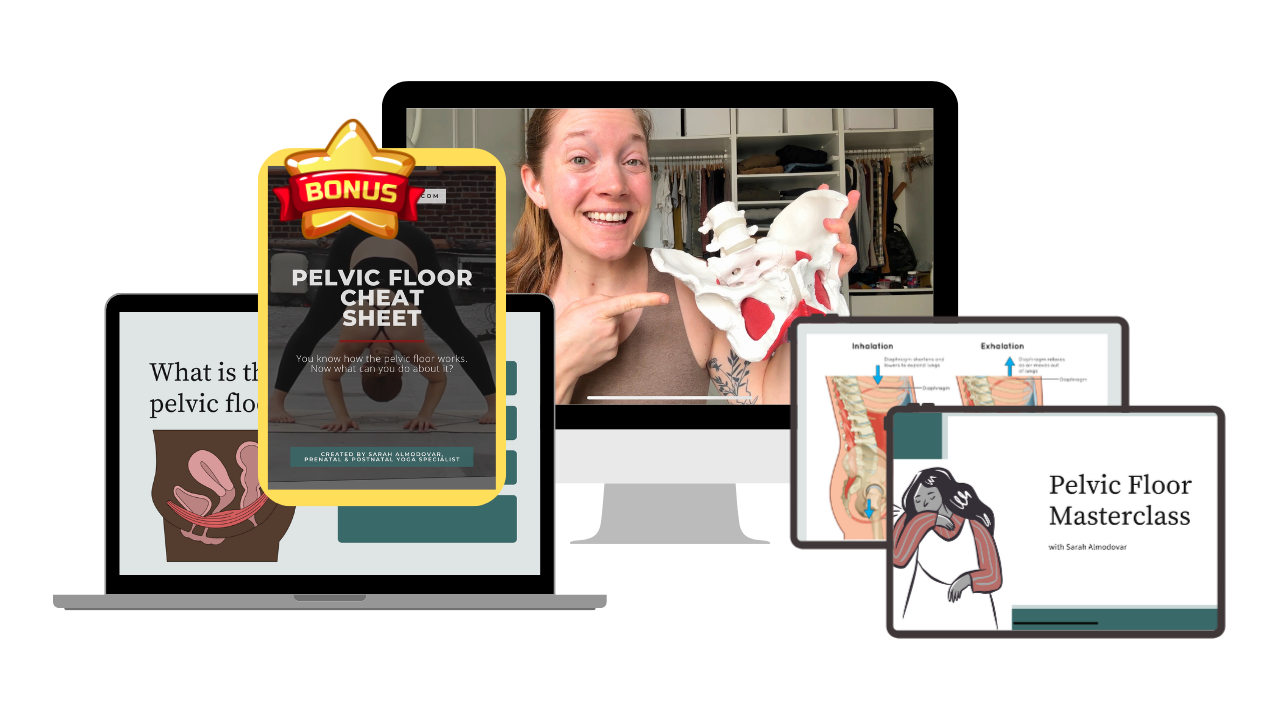
01 — Why your pelvic floor actually matters for birth (and why kegels alone won't cut it)
You'll finally understand what the pelvic floor does, why it tends to get tight during pregnancy, and why a pelvic floor that can't relax — not just one that's weak — is what often gets in the way of a smooth labor.
02 — The core canister system — how your breath and your pelvic floor move together
Your diaphragm and pelvic floor are a team. Learn how they work in unison so you can use your breath to deliberately relax and engage your pelvic floor on demand.
03 — The jaw-pelvis connection — why relaxing your jaw can help open your pelvis
There's a direct physical and neurological connection between your throat and your pelvic floor. Learn how the two work together, and why that matters for birth.
04 — The symptoms that may already be showing up
Leaking, pressure, tailbone pain, constipation — learn what these symptoms might be telling you about your pelvic floor and your birth.
Here's everything you get for $27:
✓ The live masterclass. 30 minutes on Zoom with me.
✓ A simple daily pelvic floor practice you can start that same night. No kegels required.
✓ What your symptoms might be telling you. What leaking, tailbone pain, and constipation could mean for your birth.
✓ BONUS: The Pelvic Floor Cheat Sheet. A one-page printable with 2 short practices to keep doing after class, including a 3–5 minute flow.
✓ 48-hour replay. Can't make it live? Watch on your own time.
All for $27.
Join LIVE for $27!Here's what happens when you actually understand how the pelvic floor works:
This class is your roadmap to a birth story you’re proud of — no matter how it unfolds.
Hear from moms who felt calm, capable, and connected:

”
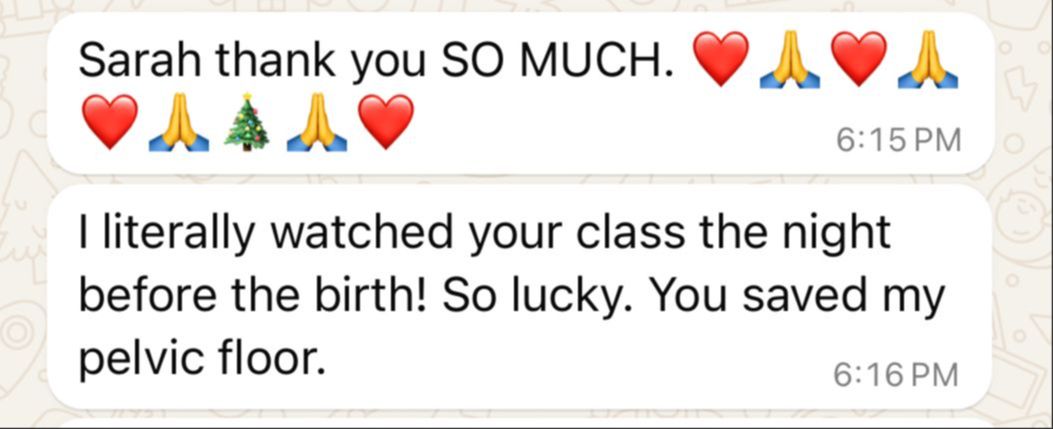
I could feel that I was going to tear badly if I pushed so I didn't want to do that, so I literally thought of Sarah in that moment of terrible pain and how I should inhale and relax the pelvic floor on my next contraction and I did and she came falling out! Sarah, thank you SO MUCH... You saved my pelvic floor.
- Maggi, mom of 2

”
This class is the perfect complement to my pelvic health PT. I learned so much about my core and pelvic floor and how they function and what I can do to strengthen them for long term quality of life.
- Katrina, first time mom

”
I had a decent working knowledge of my pelvic floor and how to properly engage it while breathing, but Sarah really helped me visualize and understand the technical aspects of my body and how all the different parts work together.
- Julissa, mom of 2
Still scrolling?
That’s okay — this isn’t about rushing you. But if even one part of you wants to feel more calm, confident, and connected as you prep for birth... you belong here.
In case you're wondering...
How long is the masterclass?
What if I can't join live?
I'm already in my third trimester. Is it too late?
I'm planning a C-section. Is this still relevant?
I've already taken a birth class. Do I need this too?
What's the Pelvic Floor Cheat Sheet?
You can't control your birth. But you can influence it.
And you have more power to do that than anyone has told you.
Most moms walk into birth hoping for the best. The ones who walk in feeling ready understood something the others didn't: that birth isn't just something that happens to you. It's something you can actively prepare for. And your pelvic floor is a big part of that.
Understanding how your pelvic floor works — what it actually does during labor, what gets in its way, and how to work with it instead of against it — can be the thing that makes you an active participant in your own birth story. Not a passive bystander. Not someone things happen to.
You deserve to walk in prepared. That starts here.
✓ Live 30-minute masterclass on Zoom
✓ A simple daily pelvic floor practice
✓ What your symptoms might mean for your birth
✓ BONUS: The Pelvic Floor Cheat Sheet
✓ 48-hour replay
Give me the tools for $27 — I'm ready to trust my body!
This program provides general wellness and educational content and is not intended to diagnose, treat, or replace professional medical care.